API Architecture
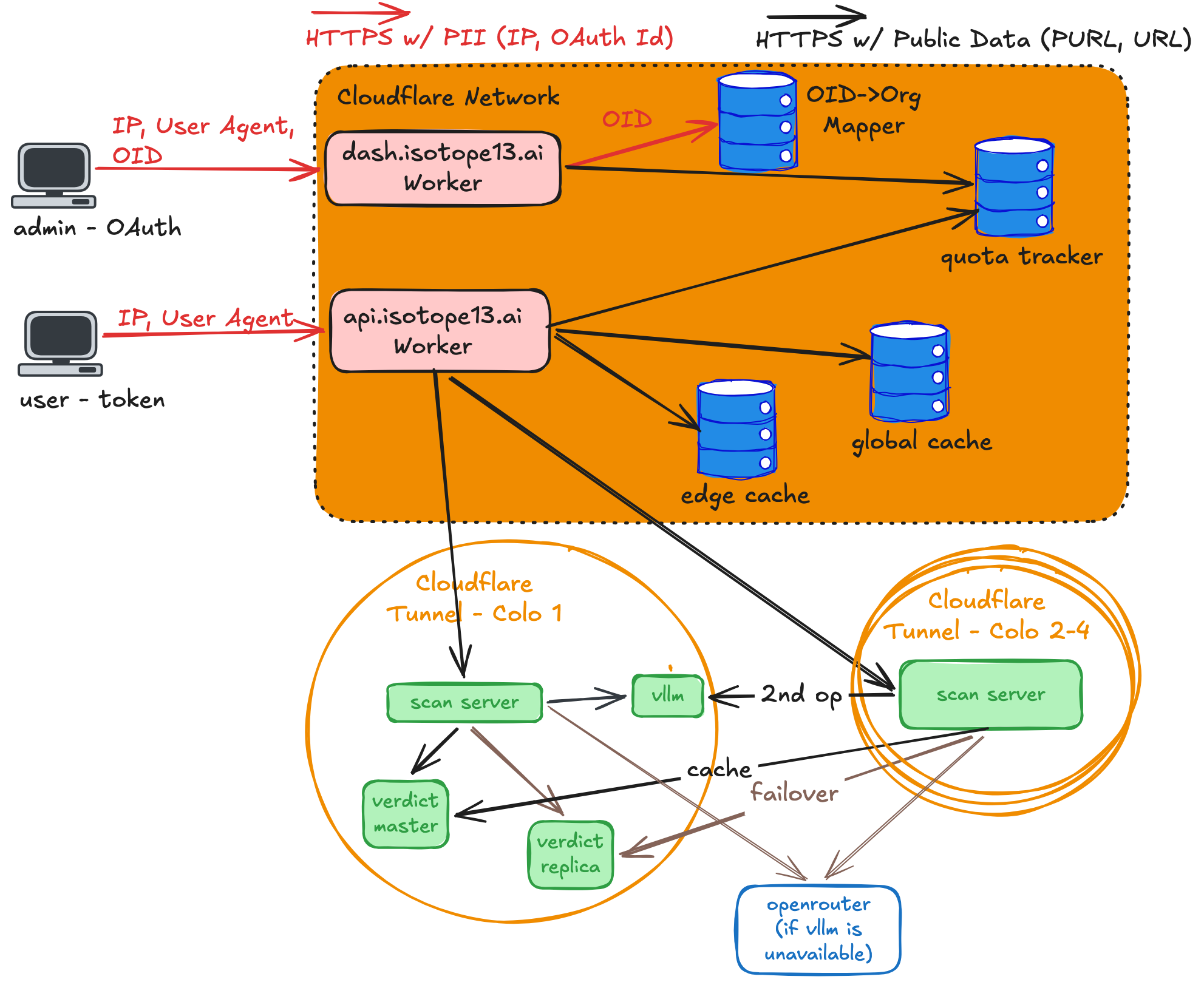
Nothing that identifies a user reaches our servers. It leaves Cloudflare only for sign-in (GitHub, Google) and billing (Stripe).
Components
Cloudflare is the only way in.
dash.isotope13.ai: customer accounts. GitHub or Google sign-in; mints API tokens.api.isotope13.ai: is this PURL, URL, hash, or file hostile? A bearer token resolves to an org for quota.
Cloudflare storage:
- OID→Org mapper (Workers KV): OAuth IDs, orgs, tokens. Only dash reads identities.
- Quota tracker (Analytics Engine): request counts per org.
- Edge cache (Workers Cache) and global cache (Workers KV): verdicts.
Scan servers run in four US colos.
Verdict master stores artifacts on disk and verdicts in PostgreSQL. Scan servers fail over to a replica.
vLLM grades borderline results from the scanner's evidence, never the file or the caller. OpenRouter is the fallback.
Data
| Data | Personal? | Where it goes |
|---|---|---|
| IP address, user agent | Yes | Cloudflare edge only; never logged |
| OAuth account ID, username or email | Yes | dash and its KV; GitHub or Google |
| Name, email, address, card | Yes | Stripe |
| Org ID, request counts | No | Quota tracker |
| PURLs, URLs, hashes, files, verdicts | Rarely, inside a file; public | Caches, scan servers, verdict store |
Retention: Privacy Policy.
Trust boundaries
- Internet → Cloudflare: TLS; OAuth for dash, bearer token for the API.
- Cloudflare → colos, and colo → colo: Cloudflare Tunnel public hostnames, bearer token. No inbound ports.
- Colos → OpenRouter: TLS, API key.